棘狀毛髮發育不良 (Trichodysplasia spinulosa)
疾病定義與分類
- 棘狀毛髮發育不良 (trichodysplasia spinulosa, TS),亦稱為病毒相關性棘狀毛髮發育不良 (virus-associated trichodysplasia spinulosa),是一種罕見、相對近期才被認識的新型毛囊病毒感染,發生於免疫功能低下 (immunocompromised) 的病人。
- 2010 年,本病被連結到一種新發現的人類多瘤病毒 (human polyomavirus),現稱為 TS 相關多瘤病毒 (TS-associated polyomavirus, TSPyV)。
- 本病主要見於實體器官移植 (solid organ transplant) 病人,尤其是腎臟移植 (renal transplant) 病人,但也可能發生於化療相關免疫抑制 (chemotherapy-associated immunosuppression) 的病人。
- TS 很可能與 pilomatrix dysplasia 以及 ciclosporine 誘發的 folliculodystrophy 為同一個疾病實體。
臨床特徵 (Clinical Features)
- TS 的特徵為多發性、細小、膚色至紅斑性的尖刺狀毛囊性丘疹 (spiky follicular papules),無症狀或僅輕度搔癢,好發於臉部與耳部。
- 病灶亦可發生於軀幹與四肢,但在這些部位通常較稀疏,且可能融合。
- 可能發生局部禿髮 (focal alopecia)。
- 當免疫抑制程度降低時,本病會改善或消退。
致病機轉與組織學特徵 (Pathogenesis and Histologic Features)
-
TS 是由活動性 TSPyV 感染毛囊所誘發。
-
電子顯微鏡 (electron microscopy) 研究已顯示細胞核內病毒顆粒,大小不一,從 30 至 46 nm。
-
受感染的毛囊細胞會聚集成簇,並表現具有推測轉化能力的 TSPyV early large tumor (LT) antigen。後者被認為會導致過度增生 (hyperproliferation)、pRB phosphorylation,以及 p16 與 p21 的上調 (up-regulation)。
-
在組織學上,anagen(生長期)毛囊呈現異常型態 (dysmorphic),伴有 infundibula 的膨脹、擴張與過度角化 (hyperkeratosis),以及異常的成熟過程,並有顯著的內毛根鞘 (inner root sheath, IRS) 分化。
-
毛囊被過量的 IRS 細胞充塞,此過程曾被描述為「彷彿毛囊完全致力於製造內毛根鞘」。
-
可見明顯具有嗜伊紅性細胞質 (eosinophilic cytoplasm) 以及大量 trichohyaline granules 的細胞 (Fig. 18.91)。外毛根鞘 (outer root sheath) 持續延伸超過 isthmus,毛球 (bulbs) 異常,缺乏完整形成的乳頭 (papillae)。常常只有少數 matrical cells,因為它們被大量具有嗜伊紅性細胞質的細胞所取代。IRS 與完全角化的毛幹 (cornified hair shaft) 之間通常沒有過渡。診斷可藉由免疫組織化學 (immunohistochemistry) 加以確認。
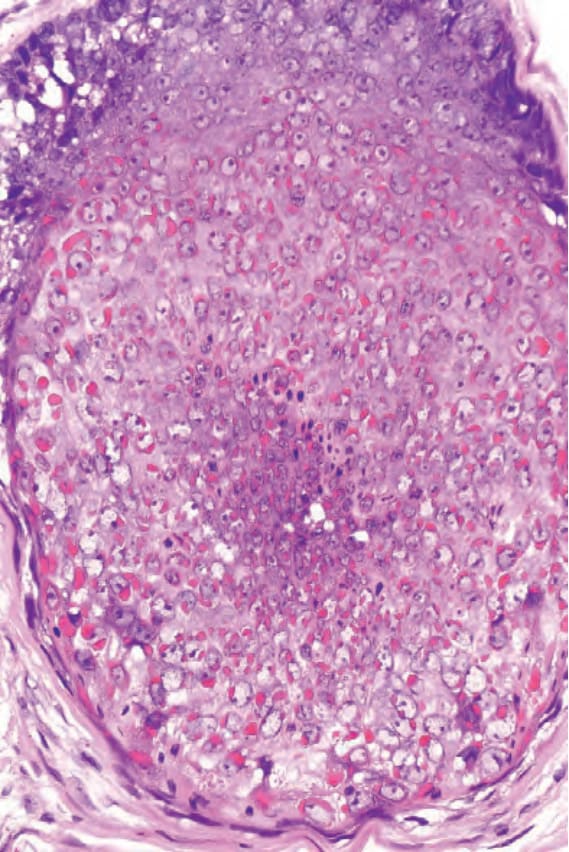
圖 18-91:棘狀毛髮發育不良 (trichodysplasia spinulosa):注意與毛囊上皮 (hair follicle epithelium) 相關的顯著細胞質顆粒性 (cytoplasmic granularity) 與嗜伊紅性 (eosinophilia)。
Fig. 18.91 Trichodysplasia spinulosa: note the prominent cytoplasmic granularity and eosinophilia in relation to the hair follicle epithelium.