Fibrosarcoma: infantile variant
Fibrosarcoma: infantile variant
Clinical features Infantile fibrosarcoma presents before the age of 10 years. The great majority of patients are less than 2 years of age and tumors are often congenital with a predilection for males.1–5 It frequently presents as a subcutaneous tumor with predilection for the limbs, but not uncommonly arises on the head and neck. Unusual locations include penis, scalp, lung, retroperitoneum, infratemporal area and heart.6–9 Some tumors can be very large. The clinical course is much less aggressive than that of its adult counterpart and the 5-year survival is higher than 80%.1–5 Local recurrence is seen in up to 25% of cases. Metastases are rare but may occur even before birth.10,11 Cases associated hypercalcemia, a case associated with coagulopathy, one with fetal anemia and a further with urticaria pigmentosa have been described.12–16 Clinically it may mimic vascular lesions or a sacrococcygeal teratoma.17–19
Histology shows a well-circumscribed mass with variable cellularity composed of small or medium-sized vascular channels with thick walls, pseudovascular spaces, a combination of round and short spindle-shaped cells and a variable number of multinucleated giant cells (Figs 35.175–35.177). The latter often seem to be lining the pseudovascular spaces. Mitotic figures are rare. The stroma is myxoid or sclerotic.
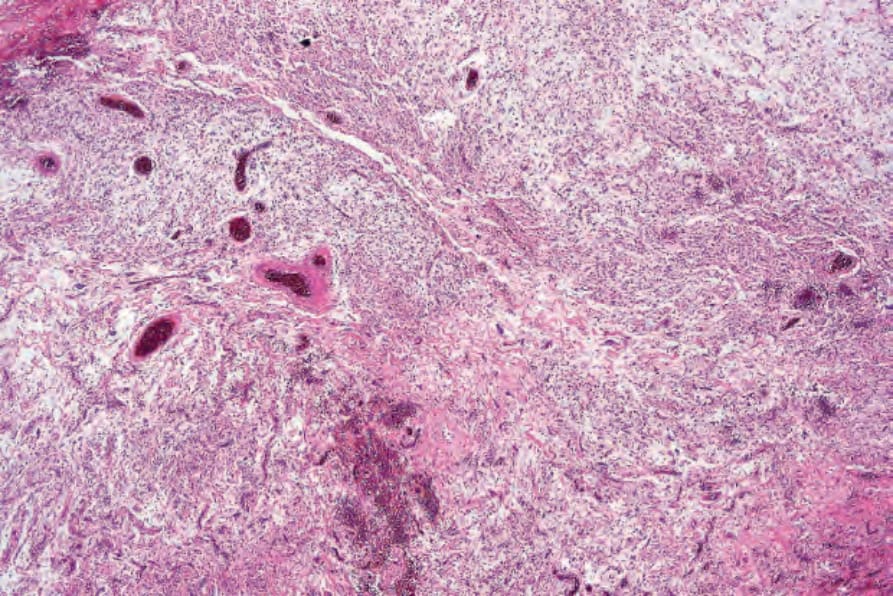
Fig. 35.175 Giant cell angiofibroma: low-power view showing prominent blood vessels and tumor cells dispersed in a myxoid stroma.