Lipofibromatosis
Lipofibromatosis
Clinical features Lipofibromatosis is a neoplasm that presents in children as a subcutaneous mass measuring from 1 to 7 cm and involving mainly the upper and lower limbs, with predilection for the hand.1–4 Rare cases may present in the head and neck and back.5–7 Cardiac and orbit lesions have been reported.8,9 The rate of local recurrence or persistence is reported as being 72%.1–4
Pathogenesis and histologic features In a single case a three-way translocation t(4;9;6) has been described.10
Histology reveals large amounts of mature adipose tissue combined with a focal spindled fibroblastic element that tends to be localized mainly in the septa of the fat or within the neighboring skeletal muscle.1–3 Cytological atypia and mitotic figures are rare and univacuolated cells may be seen in the interface between the mature adipose tissue and the fibroblastic fascicles. Rarely, pigmented cells that are positive for melanocytic markers are seen.6 Congenital infantile fibrosarcoma with lipofibromatosis-like areas may occasionally be seen.11 Beta-catenin expression is not seen.12
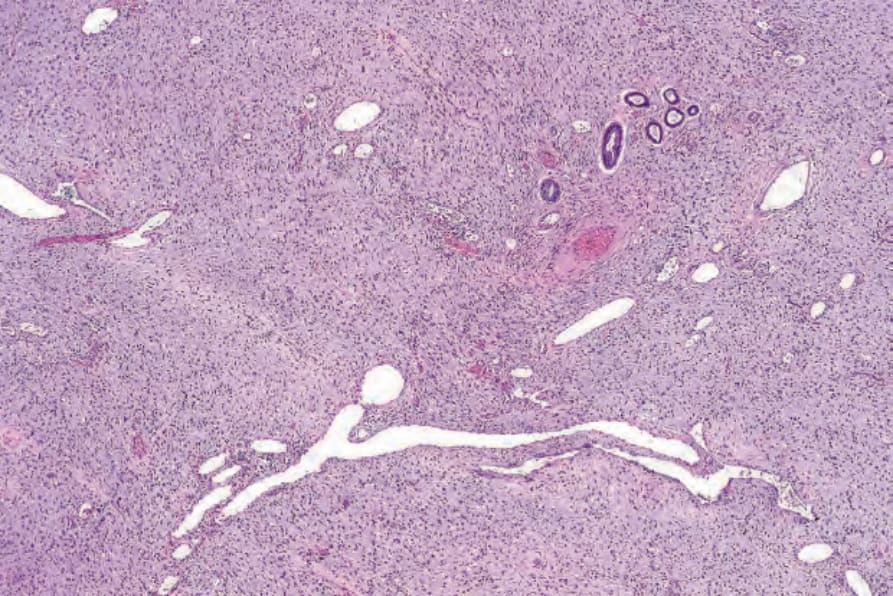
Fig. 35.135 Giant cell fibroblastoma: the admixture of dilated vessel-like spaces and mixed spindled and giant cells in a myxoid stroma is characteristic.