Glomeruloid hemangioma
Glomeruloid hemangioma
Clinical features Glomeruloid hemangioma is a distinctive reactive vascular proliferation that has been described almost exclusively in patients with multicentric Castleman disease and POEMS (polyneuropathy, organomegaly, endocrinopathy, M-protein and skin changes) syndrome (Crow-Fukase syndrome).1–5 Patients present with numerous vascular papules on the trunk and limbs and this may be the initial presentation of the disease.6 In one patient, intracranial hemangiomas were also seen.7 Exceptionally, one or multiple lesions have been described in patients with no evidence of POEMS syndrome.8–11 The latter includes a case of a single lesion presenting in the uterus.12
Histologic features The lesion is characterized by dilated vascular spaces within the dermis. These spaces display papillary projections lined by plump endothelial cells with no cytologic atypia and containing cytoplasmic hyaline globules. The latter have been shown to represent giant lysosomes, as demonstrated by electron microscopy. These lysosomes contain cellular debris and fat vacuoles (thanatosomes).
It has been suggested that glomeruloid hemangioma and papillary hemangioma are part of the same spectrum.2 The latter, however, is not associated with POEMS syndrome, lacks a glomeruloid architecture and is characterized by thick basement membrane-like material and pericytes within the cores of the papillary projections.3 Whether papillary hemangioma represents a solitary variant of glomeruloid hemangioma not associated with POEMS syndrome has not been clearly established.
Histologic features Histologically, appearances vary from small capillary hemangiomas (identical to cherry angiomas) to those of glomeruloid hemangioma or even a mixture of both. In the latter, there are dilated vascular spaces in the dermis, containing in their lumina clusters of capillaries surrounded by pericytes and strikingly resembling renal glomeruli (Figs 35.447 and 35.448). Occasional
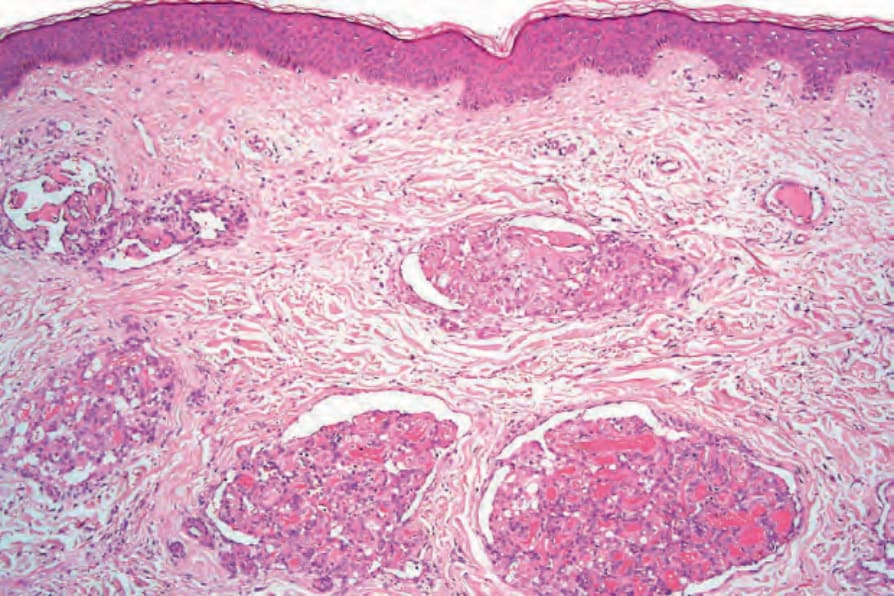
Fig. 35.447 Glomeruloid hemangioma: there is striking intraluminal capillary proliferation.