Diffuse cutaneous mastocytosis
Diffuse cutaneous mastocytosis
This is very rare and affects mainly children and only rarely adults.13,46–48 The skin is erythrodermic, often itchy, and, due to the widespread infiltrate of mast cells, has a thick doughy or boggy consistency, with accentuation of surface markings. Occasionally, the skin may have a red, yellow-brown, ‘peau d’orange’, or grain leather (‘peau chagrine’) appearance.38 Lichenification is sometimes evident. Urtication and blister formation following mild trauma are usual.38,46 Generalized blistering may occur, sometimes mimicking staphylococcal scalded skin syndrome or bullous erythema multiforme.49–51 Diffuse cutaneous mastocytosis commonly resolves by the
third to fifth years.11 Systemic symptoms include flushing, hypotension, shock, and diarrhea.11
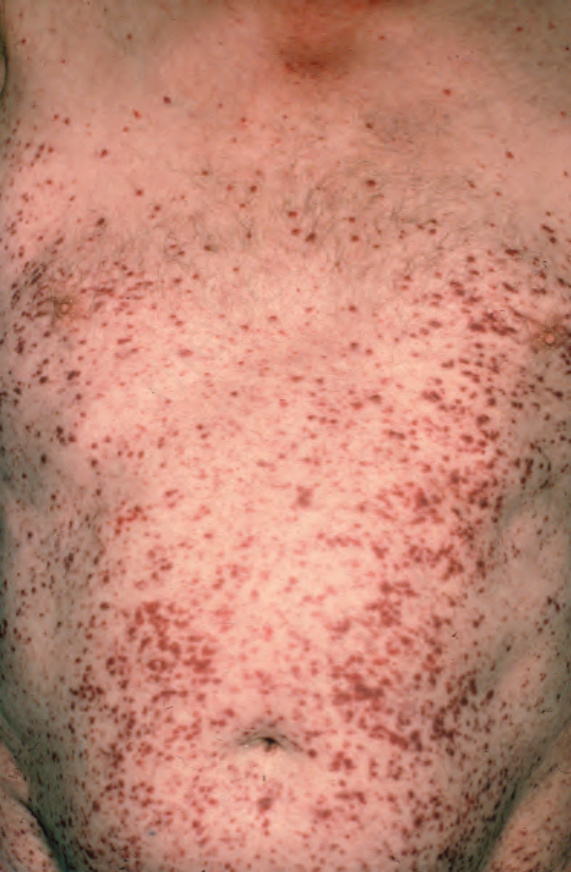
Fig. 29.350 Urticaria pigmentosa: note the generalized distribution of the lesions. From the collection of the late N.P. Smith, MD, the Institute of Dermatology, London, UK.