Woolly hair
Woolly hair
Clinical features The term woolly hair refers to prominent curly or coiled hair involving the scalp in a focal or diffuse manner that affects persons of non-African ancestry. Woolly hair can appear as a symptom of some systemic diseases, or without associated findings. When it is not syndromic, it can be classified as: a diffuse autosomal dominant variant, a diffuse autosomal recessive variant, or a localized, circumscribed variant.
Hereditary dominant woolly hair usually occurs unaccompanied by other diseases and affects the whole scalp. It appears within the first months of life. The underlying associated genetic defect has not been identified.1
Patients are born with woolly hair, and around the first year of life develop palmoplantar keratoderma. Naxos disease (palmoplantar keratoderma with arrhythmogenic right ventricular cardiomyopathy and woolly hair) manifests in adolescence with 100% penetrance. The initial symptoms are characterized by syncope, ventricular tachycardia, or sudden death. Symptoms of right heart failure appear during the end stages of the disease.28–30 The cause is mutations in the genes encoding the desmosomal proteins plakoglobin and desmoplakin.31–34 Defects in the linking sites of these proteins can interrupt the cell adhesion causing cell death, progressive loss of myocardium, and fibrofatty replacement. The disease locus has been mapped to chromosome 17q21.35–39 Other genes encoding different components of the desmosome have been reported.40
In the autosomal recessive variant, hair is short and fragile with a light, pale color at birth. The genetic defect of autosomal recessive woolly hair has been found in chromosome 13q14.2–14.3, gene P2RY5, which encodes a G protein-coupled receptor. P2RY5 is expressed in both Henle and Huxley layers of the inner root sheath. Another mutation has been described in the lipase H gene (LIPH) found in chromosome 3q27. Both mutations have been related to autosomal recessive hypotrichosis, a rare hair disorder characterized by sparse hair on scalp and the body of affected individuals.2–7
The localized circumscribed variant presents at birth or early infancy and is known as woolly hair nevus. This is an uncommon disease that affects a localized area where the hair tends to be lighter and thinner than in the rest of the scalp (Fig. 22.186). Up to 50% of cases are associated with an epidermal nevus in the skin adjacent to the woolly hair nevus or elsewhere
Carvajal syndrome is a more severe variant of Naxos disease. The cardiomyopathy manifests at an earlier age and involves mainly the left ventricle, although if may affect both. Similar to Naxos disease, it is characterized by woolly hair and palmoplantar keratoderma. It is also caused by a recessive mutation in desmoplakin. Most cases have been described in Ecuador and in India.41–43 The clinical diagnosis must be confirmed by a myocardial biopsy showing fibrofatty replacement.
Another cardiac manifestation described with woolly hair is mitral valve regurgitation, associated with subcapsular cataracts.44
Histologic features The changes are variable and range from completely normal hair with a normal hair growth rate to hairs with wide twists over several millimeters along their longitudinal axis. Hair shafts have oval, flattened, triangular, and irregular shape or are of reduced diameter.45,46 The hair composition of keratin and amino acids is normal.
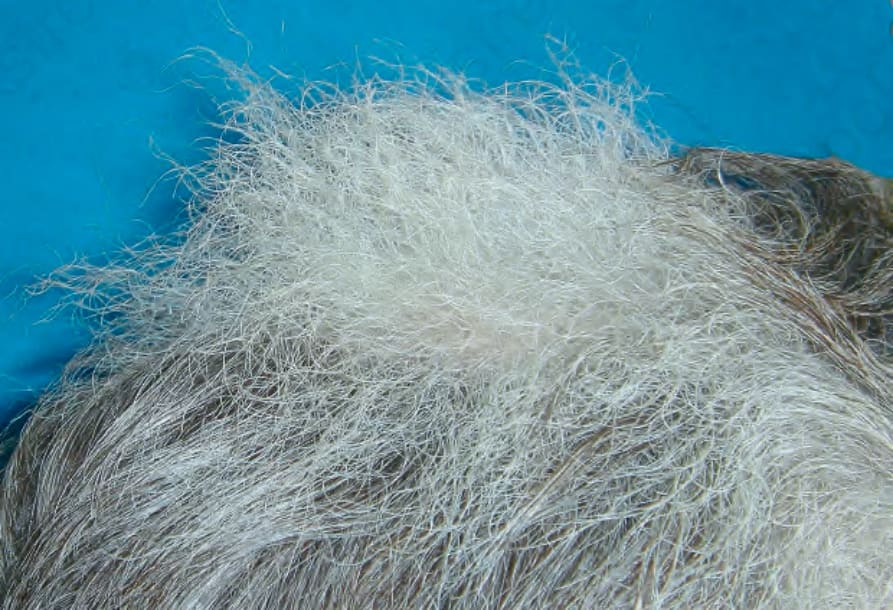
Fig. 22.186 Woolly hair: note the tightly coiled golden hair. Courtesy of A.M. Aristizábal, MD, CES, Medellín, Colombia.