Pili torti
Pili torti
Other reported abnormalities associated with monilethrix are mostly of ectodermal origin, and include juvenile cataracts, cutis laxa, dermal abnormalities, nail disorders, syndactyly, mental deficiency, epilepsy, spinocerebellar ataxia, schizophrenia, argininosuccinic aciduria, growth retardation, holt-oram syndrome, and hereditary unilateral external auditory canal atresia.5–7
The condition may be diagnosed prenatally by biopsy of chorionic villi.8
Clinical features Pili torti represents one of the coiling and twisting abnormalities of the hair shaft. Four main variants have been identified.1,2 In the classic early-onset Ronchese type of pili torti, the hair from the entire scalp, eyebrows, and eyelashes looks dry, short, and fragile from the first 2 years of life. It initially presents in the occipital area in early infancy and extends gradually. The hair is fragile and usually breaks within the first few centimeters. In the light, the hair appears to be adorned with sequins. Inheritance patterns are variable, and the underlying genetic defect has not been identified.2 Late-onset Beare type is an autosomal dominant disorder which typically presents with breakage of the hairs of the eyebrows and eyelashes in white patients. The onset of this disorder is in childhood or after puberty.
In patients with Menkes syndrome, the main hair finding is fragility due to pili torti. Menkes syndrome is an X-linked recessive disorder of copper metabolism. After birth, hairs gradually become sparse, short,
1118 Diseases of the hair
fragile, brittle, and depigmented, resembling steel wool.3–5 In a number of patients, sensorineural loss of hearing has been reported associated with clinical hair changes of pili torti, which is known as Björnstad syndrome. Moreover, when these two findings appear with hypogonadism, the condition is called Crandall syndrome. The former has an autosomal recessive pattern of inheritance caused by mutations of the gene BCS1L mapped to chromosome 2q34-q36.6–10
Pili torti has also been associated with ectodermal disorders such as pachyonychia congenita type 2 (with particular involvement of the eyebrows and facial hair), hypohidrotic ectodermal dysplasia, Bazex-Dupré-Christol syndrome (follicular atrophoderma, multiple basal cell carcinomas and hypotrichosis), Marie-Unna hereditary congenital hypotrichosis, Rapp-Hodgkin ectodermal dysplasia syndrome, ectrodactyly-ectodermal dysplasia-clefting syndrome, onychodysplasia, and hyperkeratosis palmoplantaris striata.11–18
Acquired pili torti is due to trauma. It can be associated with diverse forms of alopecia. Pili torti has also been reported with acquired structural defects of the hair similar to those observed in pseudopélade, suggesting that the disorder may be due to a dysfunctional hair papilla secondary to fibrosis.19 Other associations reported include: mitochondrial diseases, synthetic retinoids, citrullinemia, argininosuccinic aciduria, juvenile macular dystrophy, anorexia nervosa, and Netherton syndrome. Pili torti has been described on the abdomen of hirsute men and women.20–28
Pathogenesis and histologic features The twisting and abnormal molding of the hair shaft is likely due to alterations of the inner root sheath, probably due to mitochondrial dysfunction. 29,30
Histologic examination shows flat hairs that are twisted 180° on their axes at irregular intervals. The twisting may rarely occur at different angles varying from 90° to 360°. At the torsion sites, the hair is fragile and breaks easily, resulting in trichoptilosis. The phenomenon of many hairs twisted in a double spiral is called corkscrew hair.
The sequin-like clinical appearance is due to the irregular reflection of light on the twisted surface.
Differential diagnosis Pili torti is frequently confused with monilethrix because of similar light microscopic appearances. Scanning electron microscopy readily affords their distinction.
in the skin.1,8–10 Woolly hair nevus has been associated with epidermal nevus syndrome and precocious puberty, persistent pupillary membrane, verrucous epidermal nevus, systematized linear epidermal nevus, loose anagen hair syndrome, intractable infant diarrhea, osteoma cutis with multiple café-au-lait spots, pachyonychia congenita, ectodermal dysplasia-skin fragility syndrome, Pallister-Killian syndrome, ichthyosis, familial keratosis follicular spinulosa decalvans, and ulerythema ophryogenes.11–25 In some cases, a woolly hair nevus can follow Blaschko lines, suggesting a mosaic disorder. The underlying genetic defect has not been identified.
Woolly hair has also been described in association with cardiac abnormalities such as Naxos disease, Carvajal syndrome, and Naxos-like disease.26 The first condition, an autosomal recessive disorder which affected multiple families on the Greek island of Naxos, was first described in 1986.27 Since then, it has also been documented in other countries.
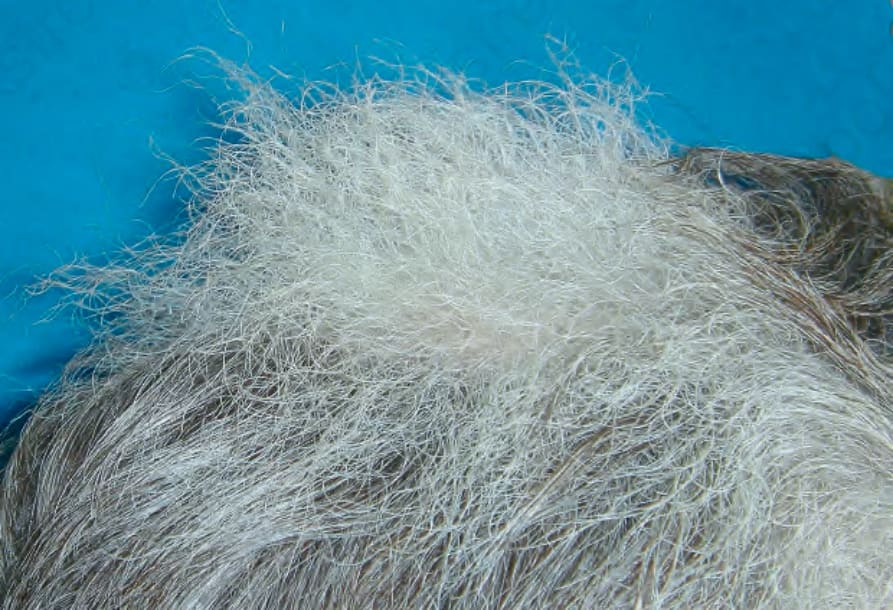
Fig. 22.186 Woolly hair: note the tightly coiled golden hair. Courtesy of A.M. Aristizábal, MD, CES, Medellín, Colombia.