Trichorrhexis invaginata
Trichorrhexis invaginata
Histologically, the hair shaft shows a dome-shaped expansion at the proximal end. This results from invagination of the distal segment into the proximal segment. The resulting deformity resembles a joint or a ‘cup and ball’ (Fig. 22.178). The nodules are very fragile and the hair sample must be taken with great care so that they remain intact. If the sample is obtained by traction, only the distal ends of the hair shaft will be obtained, and these are not suitable for diagnosis. When only the proximal half of the invagination with its dome-shaped morphology is observed, its appearance is characteristic and described as ‘golf-tee’ hair or a tulip.9
Clinical features Trichorrhexis invaginata (bamboo hair) represents an alteration of the hair shaft characterized by development of small nodules at variable intervals along the length of the hair shaft, giving it a bamboo cane-like appearance. This results in very fragile hair that breaks readily, leaving it short and thin. The hair of the eyebrows and eyelashes may also be affected.
Trichorrhexis invaginata is typical of Netherton syndrome, which was described in 1958. This is an autosomal recessive disorder with variable penetrance, characterized by trichorrhexis invaginata, ichthyosis linearis circumflexa or ichthyosis vulgaris, and atopic dermatitis. The latter occurs in about 75% of patients.1 The presence of trichorrhexis invaginata is necessary for the diagnosis of Netherton syndrome.
The degree of hair involvement varies in severity but tends to be more pronounced in girls. This is apparently due to girls wearing their hair longer, which is then more susceptible to trauma. The clinical manifestations of Netherton syndrome generally appear in the first weeks of life and are
The morphological features of trichorrhexis invaginata result from mechanical factors acting upon the hair shaft while it is still within the follicle. It is thought that invagination occurs because the proximal end of the hair follicle is impacted into the distal segment.
Ultrastructural findings are suppression of cornification, with absence of keratohyalin granules and decrease of keratin filaments. In some cases, the pathological findings are more prominent in vellus hairs than in terminal hairs.3
Differential diagnosis Although trichorrhexis invaginata is characteristic of Netherton syndrome, it can occasionally be observed as a consequence of trauma or in association with other hair shaft disorders.10
1114 Diseases of the hair
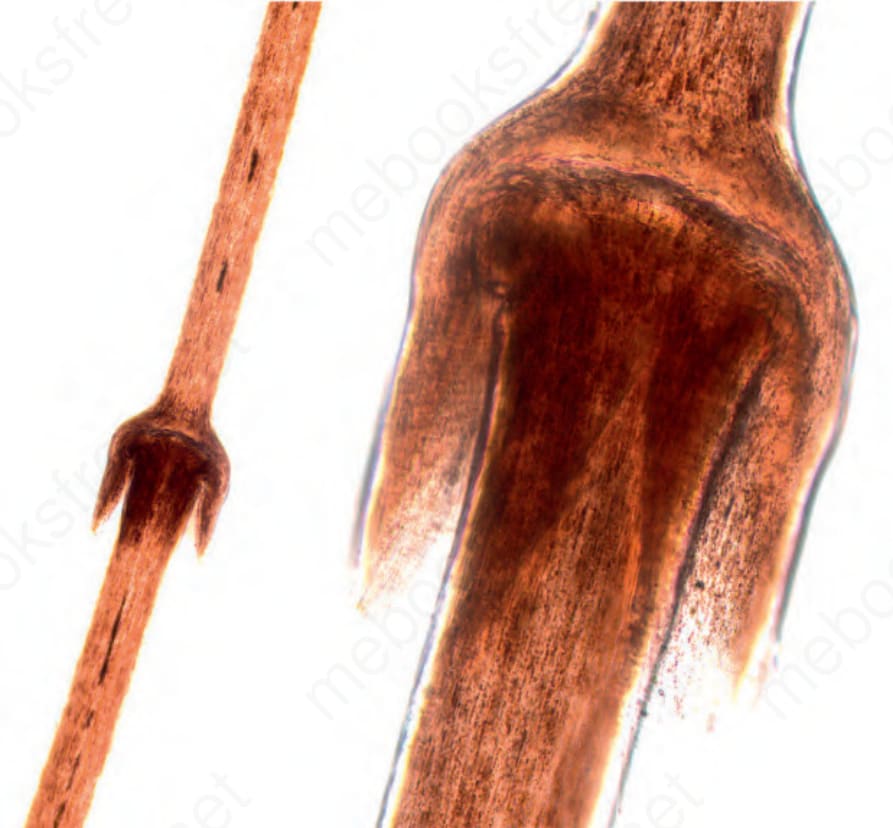
Fig. 22.178 Trichorrhexis invaginata: this is pathognomonic of Netherton disease. It represents impaction of the lower element of the hair shaft on the upper segment. This occurs within the hair follicle. Courtesy of N. Valderrama, MD, Cali, Colombia.