CLASSIFICATION OF ALOPECIA
CLASSIFICATION OF ALOPECIA
Classification of alopecia is often difficult, both from a clinical perspective and in terms of etiology. Commonly, the cause cannot be identified, and there is considerable clinical and histologic overlap in the different types of alopecia. Many classifications have been proposed, and the most widely accepted divides alopecia into those that are patterned and those that diffusely involve the scalp and into cicatricial and noncicatricial (scarring and nonscarring) variants. Nonscarring alopecia is reversible whereas scarring alopecia is permanent. The follicular loss in the latter may result from the scarring process or develop independently.
1065 Nonscarring alopecias
Androgenetic alopecia is more frequent in whites than in black men.20 Association of androgenetic alopecia with smoking has been observed among Asian men.21 The frequency appears to be increasing in this ethnic group.22 Androgenetic alopecia appears to be more common in males with X-linked recessive ichthyosis.23 Male-pattern baldness has been also associated with a susceptibility locus at chromosome 20p11.22.24 Some patients may also have associated trichodynia.25
The main problem with this classification is that there is a great degree of overlap, and clear-cut distinction is frequently not possible. In addition, some variants of alopecia (e.g., alopecia areata, trichotillomania, and traction alopecia) have a biphasic pattern: they are initially nonscarring but may become permanent (scarring) with time.
Scarring alopecias are classified into primary and secondary variants. Primary scarring alopecias are those in which the hair follicle is principally involved, as occurs in lichen planopilaris and lupus erythematosus. In the other variants, the hair follicle is not the main target of the inflammatory process and is destroyed as a secondary phenomenon. Examples of the latter include physical causes such as irradiation, infiltration of the scalp by tumor, inflammatory diseases including morphea, and infectious processes as may occur with fungi.1–4
In females, the hair loss is patterned and characterized by progressive thinning over the frontal/parietal scalp, retention of the frontal hairline, and the presence of miniaturized hairs. The process is noted as widening of the central part of the scalp (Fig. 22.36). Female pattern hair loss is much less frequent than in men, and complete baldness very rarely ensues. The hair loss often starts around the onset of the menopause, although occasionally
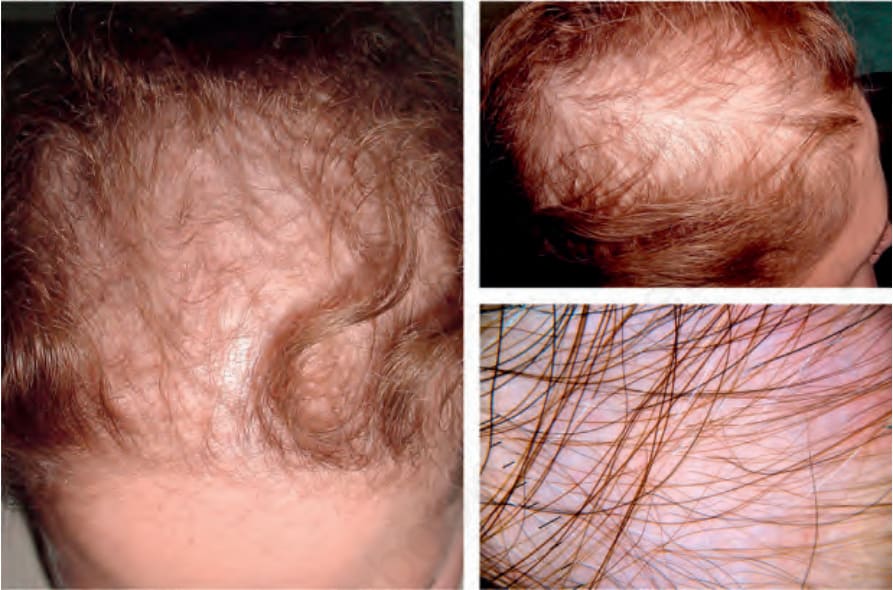
Fig. 22.36 Female pattern hair loss: this example shows a typical example with parietal and posterior frontal hair loss. Note the sparing of the frontal hairline. In the dermoscopic image on the right lower panel, note the hair loss due to extensive miniaturization on a noninflammatory background. Courtesy of L.M. Gómez, MD, UPB, Medellín, Colombia.