Pitted keratolysis
Pitted keratolysis
Clinical features Pitted keratolysis (keratolysis plantare sulcatum) is an unusual bacterial infection of plantar skin occurring predominantly, but not exclusively, in humid tropical regions of the world.1–3 The condition has been recorded in soldiers and paddy field workers, but may even be encountered among office workers.4–7 Although the cause of the disease remained elusive for many years, it was later ascribed to infection with Corynebacterium spp. Two additional Gram-positive organisms have since been implicated: Kytococcus (formerly Micrococcus) sedentarius and Dermatophilus congolensis.1–3,8,9 The disease occurs predominantly in young men. Children are rarely affected.10 Frequent presenting symptoms include hyperhidrosis, malodor, or even sliminess of the feet.2,7,11 Soreness and pruritus may also occur. D. congolensis causes a variety of dermatitides in domesticated herbivores, and it has been suggested that human infections with the latter organism result from contact with infected animals or contaminated soil.12
As indicated by the name, pitted keratolysis is associated with superficial pitlike erosions of the stratum corneum of the plantar skin. These coalesce to form characteristic crateriform defects which are concentrated on the pressure-bearing areas of the foot (Figs 18.237 and 18.238). The circular crateriform pits measure 0.7 mm or more in diameter and appear to be distributed along the plantar furrows.1–3,11,13 Cerebriform maceration is sometimes seen.11 Rarely, the palms may be involved.3,14 The dermatoscopic appearances are said to be characteristic.13 Primary hyperhidrosis has been identified as a risk factor.15 In one report, treatment of hyperhidrosis with botulinum toxin injection led to resolution of pitted keratolysis, suggesting that hyperhidrosis itself plays a pathogenetic role in the condition.16 Additional risk factors include prolonged occlusion with shoes, barefooted walking, maceration, and prolonged contact with water. Pitted keratolysis
913 Sago palm disease
being almost vertical in configuration.1,2 Special stains (Gram, methenamine silver, PAS or Giemsa) are required to visualize the organisms, which comprise both coccoid and filamentous forms.1,2,9 The coccoid forms tend to be concentrated near the surface of the pit whereas the filamentous forms are present in relation to the deeper portions of the defect.2,9 The filamentous forms show both branching and septation. The filamentous form of D. congolensis is characteristically composed of chains of small coccoid bodies.1 Ultrastructural examination reveals a diminished stratum corneum, the opening of tunnels within the latter, and the presence of coccoid bacteria with transverse septation.18
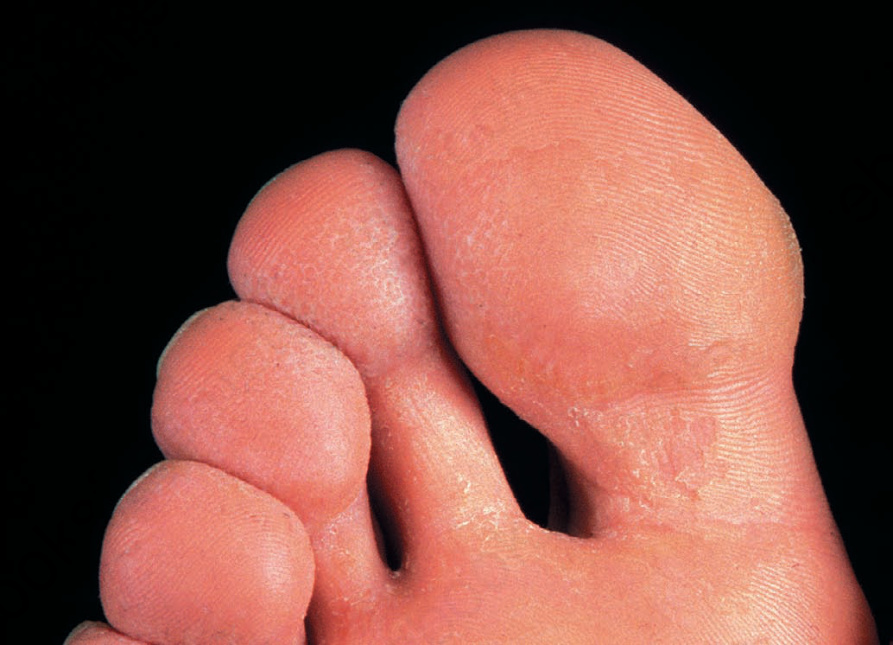
Fig. 18.237 Pitted keratolysis: note the typical scaliness and pitlike areas. By courtesy of the Institute of Dermatology, London, UK.