Hartnup disease
Hartnup disease
Clinical features Hartnup disease is an autosomal recessive disorder characterized by defective gastrointestinal absorption and renal reabsorption of monoamine and monocarboxylic amino acids due to a defect in the neutral brush border system.1 One of the effects is tryptophan deficiency.2 The disease typically presents in childhood. In addition to a pellagra eruption (see below), patients also have a characteristic aminoaciduria and cerebellar ataxia.3,4 An uncommon cutaneous manifestation is an acrodermatitis-like eruption involving the perioral region, perineum and acral skin.5–7 The disease may, however, sometimes be so mild as to remain asymptomatic.8 Additional symptoms include diarrhea and CNS dysfunction ranging from mild apathy to psychosis and frank dementia.7,9 An exceptional case of a patient with identical symptoms and signs of Hartnup disease in the absence of a recognized metabolic abnormality or aminoaciduria has been described.10 The disease has been mapped to chromosome 5p15 and the defective gene is SLC6A19, a sodium dependent neutral amino acid transporter.11–13
Histologic features The cutaneous histology is identical to that of pellagra (see below).
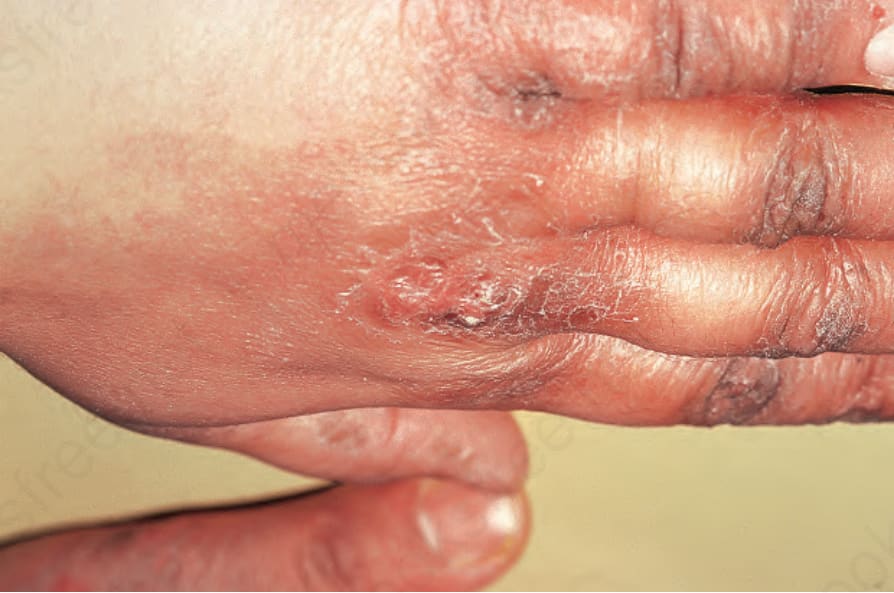
Fig. 13.139 Pellagra: scaling and hyperpigmentation are present on the dorsal aspect of the knuckles and fingers. By courtesy of the Institute of Dermatology, London, UK.