Bloom syndrome
Bloom syndrome
This rare chromosomal instability syndrome (also known as congenital telangiectatic erythema with dwarfism) has an autosomal recessive mode of inheritance and is particularly seen in East European (Ashkenazi) Jews. When found in non-Jews, there is a high incidence of parental consanguinity. It represents a genetically homogenous single locus disease without apparent heterogeneity.1
Clinical features There is a characteristic appearance with microcephaly, dolichocephaly, and small, narrow ‘pinched’ facies, and stunted growth leading to severe dwarfism.2,3 An erythematous rash with telangiectasia develops predominantly on the face (in particular, the ‘butterfly’ area) and is exacerbated by sunlight (Fig. 7.102).4,5 The rash may also affect the backs of the hands and forearms and typically develops in infancy. Café-au-lait spots are a common manifestation and discrete areas of hypopigmentation are usual.3 A peculiar
272 Lichenoid and interface dermatitis
terminations and resultant defective Bloom syndrome protein with impaired function.15 Multiple defective nuclear enzymes including DNA ligase I have been identified.19 Monosomy 7 and deletions of the long arm of chromosome 7 are found in the majority of patients with myeloid leukemia.20 A mouse model recapitulates many aspects of the human disease syndrome, including hematopoietic malignancies.21
The cutaneous lesions are typified by a lupus erythematosus-like histology. There is epidermal atrophy accompanied by liquefactive degeneration of the basal layer with cytoid body formation. A lymphohistiocytic infiltrate is present in the superficial dermis. Telangiectatic blood vessels are evident.
contractures are frequent complications, and dental abnormalities include malocclusions and caries. Involvement of the central nervous system presents as microcephaly, normal pressure hydrocephalus, mental subnormality, ataxia, choreoathetosis, spasticity, myoclonus, and gait disturbance.1,2,5 Renal function is usually impaired.6
Patients with Cockayne syndrome have an increased incidence of infections and usually die within the third decade.
An unusually severe form with early onset and quick death associated with abnormal thymidine dimer repair (and hence showing overlap with xeroderma pigmentosum) has been described.5,7
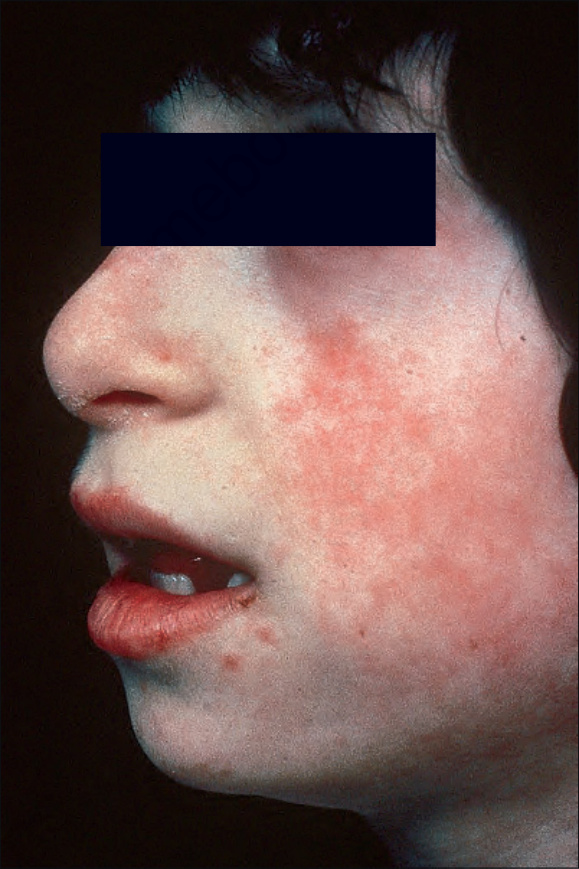
Fig. 7.102 Bloom syndrome: characteristic facies includes ‘pinched’ features. Marbled erythema of the cheek and crusted lesions involving the lower lip. By courtesy of D. Atherton, MD, Institute of Dermatology and Children’s Hospital at Great Ormond Street, London, UK.