Marginal papular acrokeratoderma
Marginal papular acrokeratoderma
Clinical features Marginal papular acrokeratoderma (palmoplantar keratoderma punctata type 3, PPKP3) refers to a complex, confusing, and overlapping group of disorders, which includes acrokeratoelastoidosis of Costa, focal acral hyperkeratosis, mosaic acral keratosis, degenerate collagenous plaques of the hands, digital papular calcific elastosis, and keratoelastoidosis marginalis of the hands.1 All present with frequently crateriform, keratotic papules along the borders of the hands and feet (Fig. 3.130).1 Although usually discrete, in some patients the papules may coalesce into plaques.
Acrokeratoelastoidosis presents in childhood and adolescence with yellowish, warty, and crateriform keratotic or pearly papules predominantly affecting the sides of the hands, wrists, fingers, and feet.2–5 There is no racial predilection and the sexes are affected equally. Patients may also develop circumscribed keratodermatous knuckle pad-like lesions, palmoplantar hyperkeratosis, and hyperhidrosis.1,3 Sporadic and autosomal dominant variants have been described. The disorder may be linked to chromosome 2.6 Repeated trauma is believed to be of etiological importance.
Focal acral hyperkeratosis and mosaic acral keratosis are histologically identical with the exception that the elastic tissue appears normal.7–12
Degenerative collagenous plaques of the hands are characterized by a dense zone of thickened and distorted collagen with fragmentation of elastic fibers and overlying hyperkeratosis and acanthosis.4,13–18 The papillary dermis is spared. Calcification is sometimes a feature (digital papular calcific elastosis).19–21 Telangiectatic vessels may also be seen and increased dermal mucin has been described.19
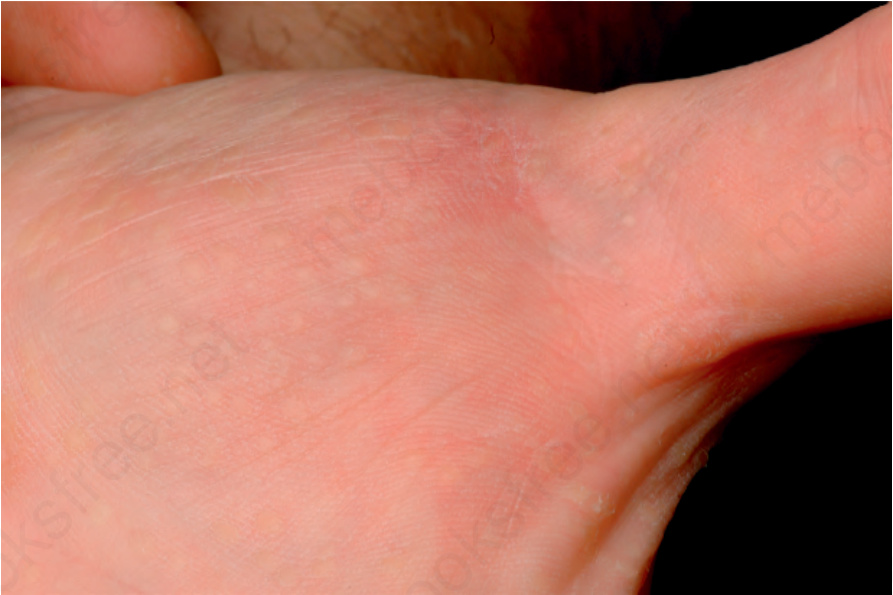
Fig. 3.130 Marginal papular acrokeratoderma: pearly papules predominantly affecting the sides of the hands, wrists, fingers.