Trichothiodystrophy
Trichothiodystrophy
Trichothiodystrophy (syn. Tay syndrome, IBIDS syndrome, PIBIDS syndrome, Amish brittle hair syndrome) represents a heterogeneous group of autosomal recessive neurocutaneous disorders, some of them photosensitive, that share sulfur-deficient brittle hairs.1 Trichoschisis and brittle hairs are due to an abnormally low hair-shaft sulfur content with a decrease in cysteine. On polarizing microscopy, an alternating light and dark banding (‘tiger-tail pattern’) appears pathognomonic (Fig. 3.54).2
Trichothiodystrophy is associated with congenital ichthyosis: the acronym IBIDS (‘Tay syndrome’) refers to the clinical findings of ichthyosis (e.g., collodion membrane), brittle hair, intellectual impairment, decreased fertility, and short stature. Other features are microcephaly, dysplasia of nails, failure to thrive, ‘progeria’-like symptoms, cataracts, and photosensitivity (≈ PIBIDS).3
In the photosensitive group, DNA-repair anomalies involving various subunits of the transcription factor TFIIH have been identified, while the non-photosensitive group, without a DNA-repair defect, exhibits mutations in the C7ORF11 gene coding for TTDN1 protein.4,5 Despite the DNA-repair defect and in contrast to xeroderma pigmentosum, an increased risk of malignancy is not regarded as a feature of photosensitive trichothiodystrophy.6
75 Other rare neuro-ichthyotic syndromes
Histology of the ichthyotic skin shows acanthosis with orthohyperkeratosis and a reduced stratum granulosum (see Table 3.3).
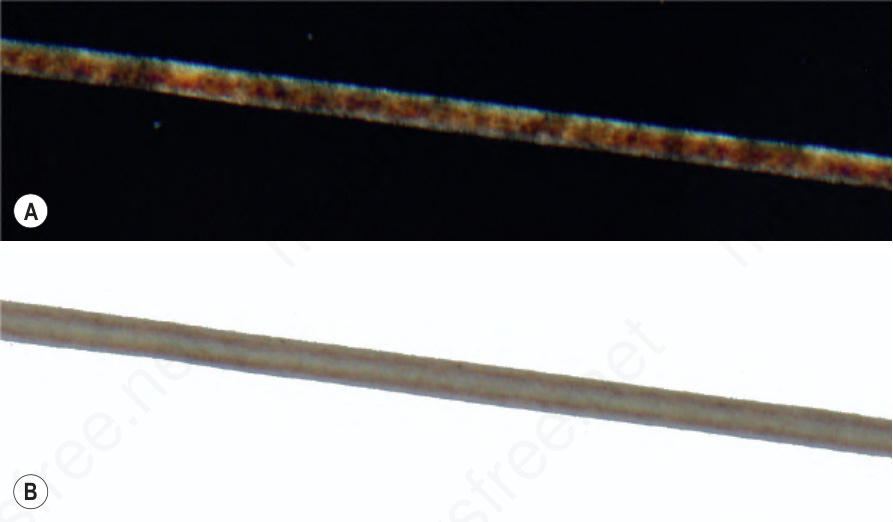
Fig. 3.54 Trichothiodystrophy: (A) polarizing microscopy of a hair shows an alternating light and dark banding (‘tiger-tail pattern’). (B) The same hair without polarizing.
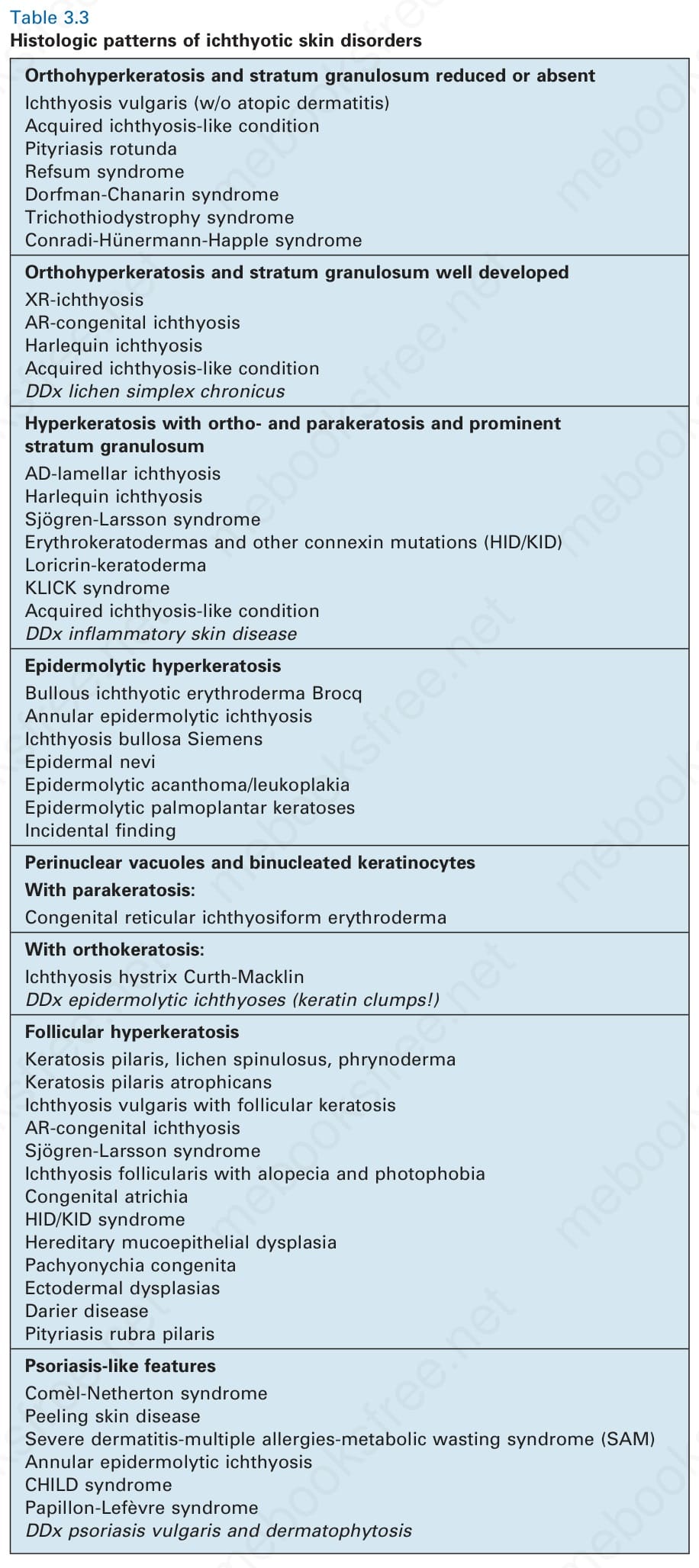
Table 3.3 Histologic patterns of ichthyotic skin disorders