斑馬魚作為皮膚疾病模型
- 穿透式電子顯微鏡 (transmission electron microscopy) 顯示基底膜帶 (basement membrane zone, BMZ) 出現擾亂 (Fig. 36.23A–B),其表現類似於因人類 COL17A1 基因突變所致之一型交界型表皮鬆解症 (junctional epidermolysis bullosa) 患者的特徵。
- abca12 morphant 魚在軀幹與尾部沿線的色素分布顯現出明顯的改變。掃描式電子顯微鏡 (scanning electron microscopy) 顯示微脊 (microridges) 消失,並在皮膚表面發育出鱗片狀棘突 (scale-like spicules),與因 ABCA12 基因突變所致的人類丑角樣魚鱗癬 (harlequin ichthyosis) 中的鱗片有幾分相似。⁴ 穿透式電子顯微鏡顯示皮膚中存在類脂質囊泡 (lipid-like vesicles)(Fig. 36.23C–D)。
- 類似的研究取徑也已被用於研究因 capn12 基因突變所致的先天性魚鱗癬 (congenital ichthyosis),以及由 svep1 基因突變所引起的表皮分化。⁵,⁶
傷口癒合與物種間保守性
- 進一步的研究顯示,傷口再上皮化 (wound re-epithelialization) 的發生獨立於發炎反應及纖維母細胞生長因子 (fibroblast growth factor) 訊息傳遞之外,而後兩者對於纖維母細胞的招募 (fibroblast recruitment) 以及肉芽組織 (granulation tissue) 的形成乃屬必要。
- 綜合而言,這些結果顯示皮膚傷口癒合的主要步驟與原則在成體哺乳動物與成體斑馬魚之間是保守的,使斑馬魚成為研究脊椎動物皮膚修復的一個有價值的模型。
模型的限制
- 相對地,那些屬於晚發或進展緩慢的疾病,在斑馬魚模型系統中可能無法顯現。此類病況的一個例子為彈性纖維假黃瘤 (pseudoxanthoma elasticum, PXE),這是一種進展緩慢、晚發的異位性礦化障礙 (ectopic mineralization disorder)。
- 在斑馬魚中注射 abcc6a morpholino 導致早期表現出心包水腫 (pericardial edema) 與尾部捲曲 (curled tail),並伴隨在受精後 8 dpf 即死亡,但在此階段並無異位性礦化的證據。⁷ 若就發育階段而言對應於人類或小鼠 PXE 的致病機轉,礦化表現型可能會在生命較晚期才出現。在此脈絡下,abcc6 knockdown 斑馬魚並非 PXE 的合適模型。
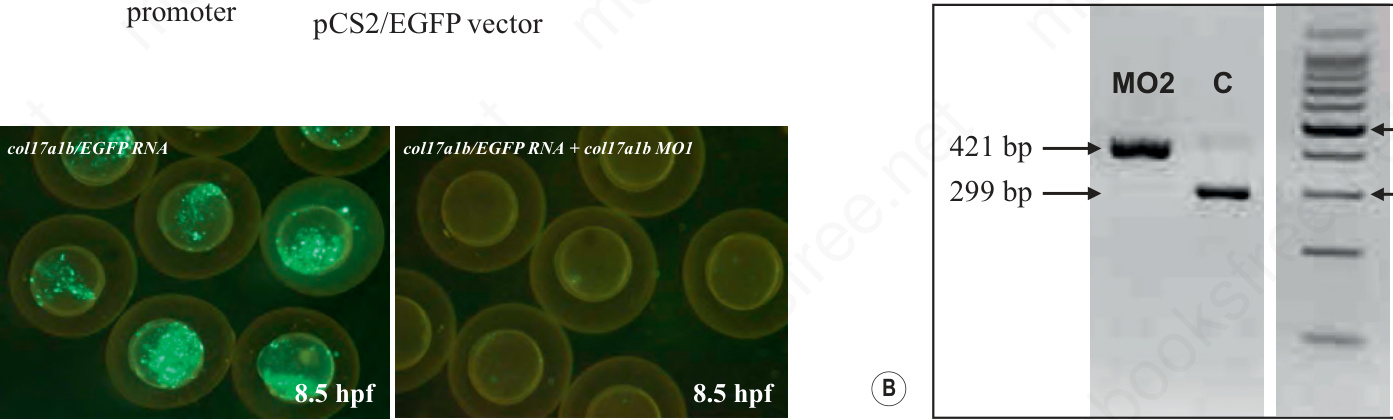
圖 36-22:斑馬魚基因之 morpholino 媒介的剔除 (knockdown)。(A) 使用一個對應於 col17a1b 基因的 morpholino (MO1) 以標定其對應 mRNA 的 5′ 非轉譯區 (untranslated region),以阻止轉譯。為判定 morpholino 在下調轉譯上的效力,建構了一個由 SP6 promoter、col17a1b 基因之 5′ UTR 以及下游加強型綠色螢光蛋白 (enhanced green fluorescent protein, EGFP) 報導基因所組成的表現構築體。將自 pCS2/EGFP 載體於體外轉錄出的 mRNA 微注射 (microinjection) 至 1–2 細胞期胚胎,於 8.5 hpf 顯示綠色螢光(左下圖)。將此 mRNA 與 MO1 morpholino 共注射則完全消除螢光,顯示轉譯受到抑制(尺標,1 mm)。(B) 將一個對應於斑馬魚 abcc6b 基因的 morpholino (MO2) 放置於 exon 18–intron 18 剪接接合處 (splice junction)。以放置於 exon 18(正向)與 exon 19(反向)的引子進行 RT-PCR,監測該 morpholino 在阻止 abcc6b pre-mRNA 剪接成成熟 mRNA 上的效率。基因體序列的 PCR 產生一個 421-bp 的片段,而完全剪接的 cDNA 則產生一個去除 intron 18(122 bp)的 299-bp 片段。對經 morpholino (MO2) 處理之斑馬魚胚胎進行 RT-PCR 僅顯示 421-bp mRNA 序列的存在,顯示由剪接移除 intron 18 的作用受到完全抑制。由於 intron 18 序列不在讀框 (out of frame),此導致 abcc6b 蛋白產物的完全缺失。dpf,受精後天數 (days post fertilization);hpf,受精後小時 (hours post fertilization);RT-PCR,反轉錄 PCR (reverse transcription-PCR);UTR,非轉譯區 (untranslated region)。改編自 Kim⁶ 與 Li⁷,經授權使用。
Fig. 36.22 Morpholino-mediated knockdown of zebrafish genes. (A) A morpholino (MO1) corresponding to the col17a1b gene was used to target the 5′ untranslated region of the corresponding mRNA to prevent translation. To determine the efficacy of morpholino in downregulating the translation, an expression construct consisting of SP6 promoter, 5′ UTR of the col17a1b gene, and downstream enhanced green fluorescent protein (EGFP) reporter gene was generated. Microinjection of mRNA transcribed in vitro from the pCS2/EGFP vector to 1–2 cell-stage embryo, shows green fluorescence at 8.5 hpf (lower left panel). Co-injection of this mRNA together with the MO1 morpholino completely abolished the fluorescence, indicating inhibition of the translation (bar, 1 mm). (B) A morpholino (MO2) corresponding to the zebrafish abcc6b gene was placed on the exon 18-intron 18 splice junction. Efficiency of the morpholino in preventing splicing of the abcc6b pre-mRNA into mature mRNA was monitored by RT-PCR using primers placed on exon 18 (forward) and exon 19 (reverse). PCR of the genomic sequence resulted in a 421-bp fragment, whereas fully spliced cDNA yields a 299-bp fragment devoid of intron 18 (122 bp). RT-PCR of morpholino (MO2)-treated zebrafish embryo reveals the presence of the 421-bp mRNA sequence only, indicating complete inhibition of the removal of intron 18 by splicing. As the intron 18 sequence is out of frame, this results in complete absence of the abcc6b protein product. dpf, days post fertilization; hpf, hours post fertilization; RT-PCR, reverse transcription-PCR; UTR, untranslated region. Adopted from Kim6 and Li,7 with permission.