Target blue nevus
Target blue nevus
Clinical features Target blue nevus refers to an exceedingly rarely documented variant that presents as a dome-shaped blue nodule surrounded by a hypopigmented or flesh-colored rim which is further bordered by a blue zone, giving rise to a targetoid appearance. Lesions may be congenital or acquired, and the dorsal surface of the foot is affected.1
Pathogenesis and histologic features The central nodule may be either a common or a cellular blue nevus in which the stroma is particularly sclerotic. The hypopigmented zone consists of dense collagen containing few dendritic cells, and the outer border is again rich in pigmented dendritic nevus cells.1 The etiology of this variant is unknown, although trauma may be an important factor.1
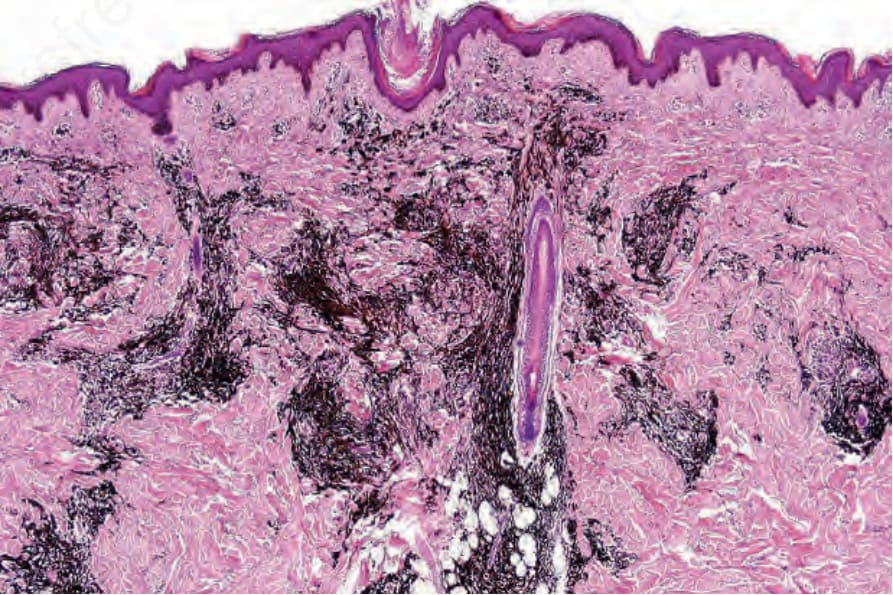
Fig. 25.227 Common blue nevus: this highly pigmented spindled cell neoplasm extensively involves the reticular dermis.