Tinea nigra
Tinea nigra
Clinical features Tinea nigra is an uncommon superficial mycosis caused by Hortaea werneckii (formerly Phaeoannelomyces werneckii or Exophiala werneckii). It occurs mainly in the tropics and presents as a slowly growing, irregular, brown, black or dark-green slightly scaly asymptomatic patch.1,2 The disease involves mainly the palms followed by the soles, and is exceptional at other sites (e.g., the fingers). Bilateral involvement may be seen.3–5 Clinical confusion with a melanocytic lesion is possible, and dermoscopy has emerged as a useful tool in reducing the risk of potential misdiagnosis.6,7 On rare occasions, tinea nigra may manifest with a speckled or ‘salt and pepper’ pattern of involvement.8
934 Infectious diseases of the skin
A
B
Histologic features The epidermis shows the presence of numerous short, segmented hyphae and spores in the superficial aspect of the stratum corneum. The organisms are easily recognized as they stain brown or yellow with H&E.
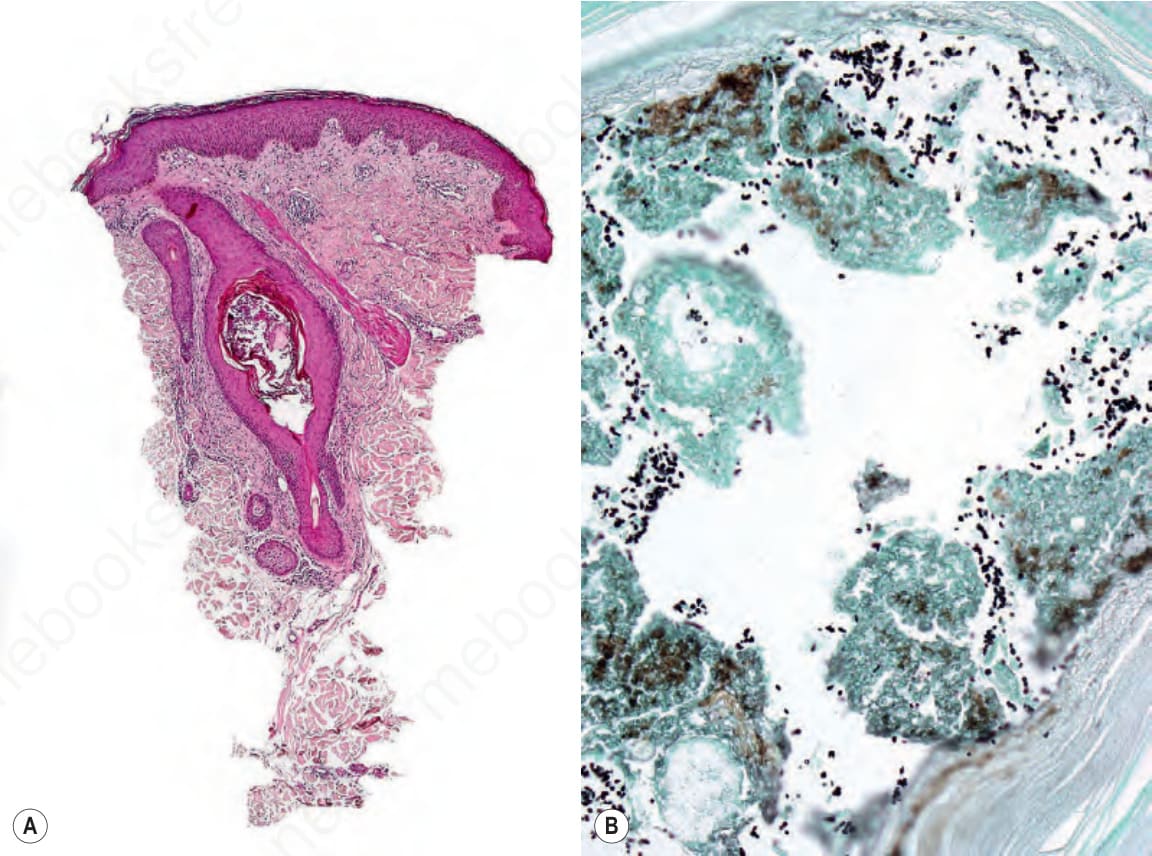
Fig. 18.292 Malassezia (Pityrosporum) folliculitis: (A) there is infundibular dilatation; (B) yeast forms are conspicuous in the methenamine silver stained section.