Iododerma
Iododerma
Clinical features Potassium iodide is encountered in various settings. It is often included in expectorants/bronchodilators and is used for treatment of thyroid disease and as a radiocontrast medium.
Adverse reactions are rare.1–9 Acneiform papulo/pustular lesions are most common and affect the face, neck, and back.3,4 Erythematous, urticarial, vesiculobullous, and pustular psoriasis-like lesions have been described.1,7,10,11 Rarely, chemical burnlike changes develop in patients, often postsurgical, when there is concomitant occlusion and maceration.9 Lesions affecting the lower limbs may be petechial, hemorrhagic, or resemble erythema nodosum.1,2 Nodular and ulcerated vegetative plaques constitute more extreme forms. This latter variant affects the face, shoulders, trunk, and extremities and presents as 1–7 cm disfiguring, crusted, erythematous lesions, sometimes with central umbilication (Figs 14.80 and 14.81).3 Healing may be complicated with scarring.
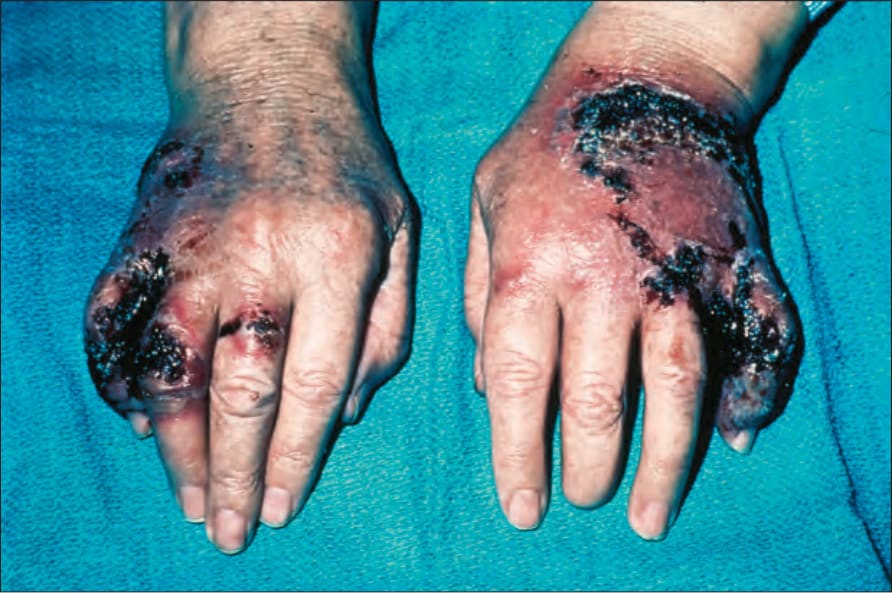
Fig. 14.80 Iododerma: ulcerated vegetative plaques are present on the backs of the hands and fingers. By courtesy of the Institute of Dermatology, London, UK.