Behcet disease
Behcet disease
Behcet disease is a rare systemic vasculitic disorder characterized by attacks of acute inflammation causing painful orogenital ulceration and ocular involvement. Other skin lesions include erythema nodosum, pseudofolliculitis or acneiform folliculitis, and pathergy. The central nervous system, cardiovascular system, and gastrointestinal system can be severely affected. The pathogenesis is unknown. There is no diagnositic test so the diagnosis is made on the basis of ranked criteria. Histology is usually non-specific and does not distinguish idiopathic aphthae but sometimes necrotising vasculitis is evident.1–3
The vulval ulcers are typically larger and deeper than aphthae and can heal with scarring.
Crohn disease is not uncommonly associated with pyoderma gangrenosum and erythema nodosum. Other links include leukocytoclastic vasculitis, erythema elevatum diutinum, granulomatous vasculitis, Sweet syndrome, epidermolysis bullosa acquisita, polyarteritis nodosa, pyostomatitis vegetans, vitiligo, psoriasis, erythema multiforme, lichen nitidus, hidradenitis suppurativa, and acne fulminans.11–22
The condition runs a chronic course. Development of Bowen disease in a case of vulvovaginal Crohn disease has been reported.23 Rarely, SCC may develop in long-standing disease.24
Histologic features The histology may show only edema, dilated lymphatics, or lymphangiectasia. More commonly, there are dermal or rarely subcutaneous noncaseating granulomata mainly of the sarcoidal type (Fig. 12.76). The latter may have a perivascular distribution.25 Granulomas are usually sparse and may be missed unless multiple sections are examined. The histologic diagnosis can only be made after careful clinicopathological correlation.
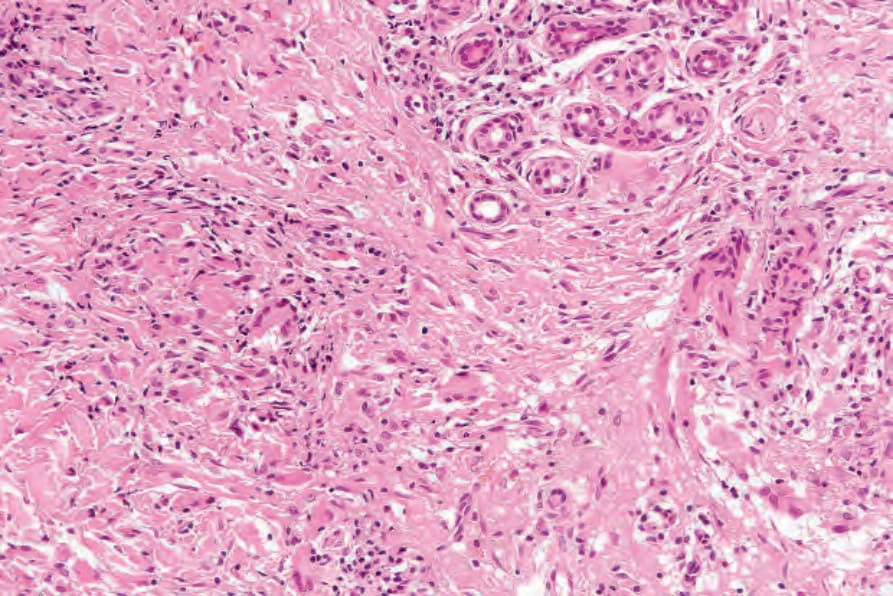
Fig. 12.76 Vulval Crohn disease: there is an ill-defined granulomatous infiltrate with conspicuous giant cells in the deep reticular dermis.