Vestibular papillomatosis
Vestibular papillomatosis
Clinical features Vestibular papillomatosis is not due to HPV infection and is a common finding of no significance.1,2 It is asymptomatic and is the female equivalent of penile pearly papules. Individual lesions are dome shaped or filiform and arise on a solitary base. They are found on the inner aspect of the labia minora and vestibule3 (Fig. 12.14).
Clinical features Pearly/pink penile papules1 may be found in 15–50% of men.2–5 They manifest as flesh-colored, smooth, rounded papules (1–3 mm) occurring predominantly around the coronal margin of the glans, and rarely on the glans. Often, there are rows or rings of papules (Fig. 12.13). Ectopic lesions, for example, on the penile shaft, have been reported,6 including in children.7 They are frequently mistaken for warts and Tyson or ectopic sebaceous glands. The lesion is analogous to other acral angiofibromas such as adenoma sebaceum, subungual and periungual fibromas, fibrous papule of the nose, acquired acral angiofibroma, and oral fibroma. These lesions may regress with circumcision and old age.8
Histologic features The histology is that of angiofibroma.9 Human papillomavirus (HPV) DNA is absent.10,11
Histologic features There is a normal or thickened epidermis overlying a central fibrovascular core.
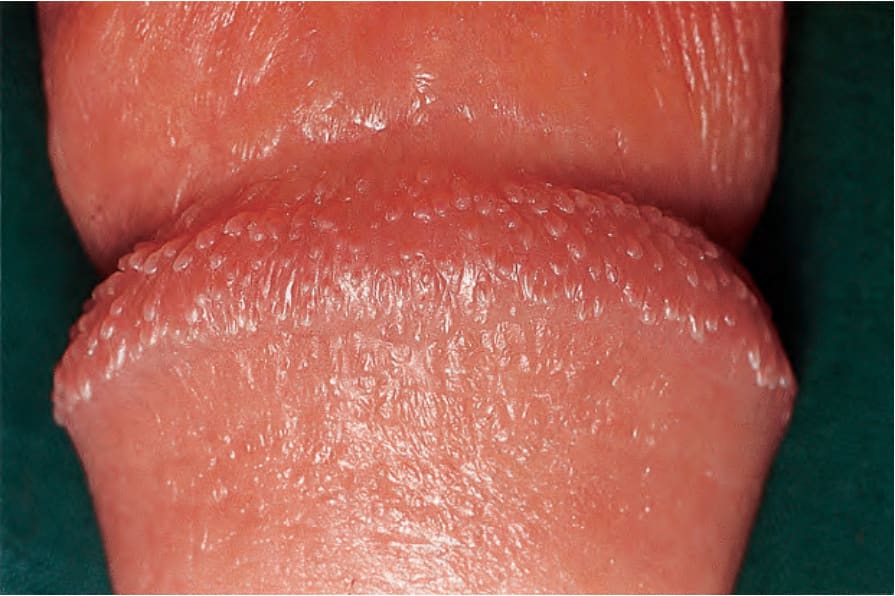
Fig. 12.13 Pearly penile papules. Glans penis, coronal rim. From Bunker C. Male Genital Skin Disease. Saunders Ltd./Elsevier 2004.
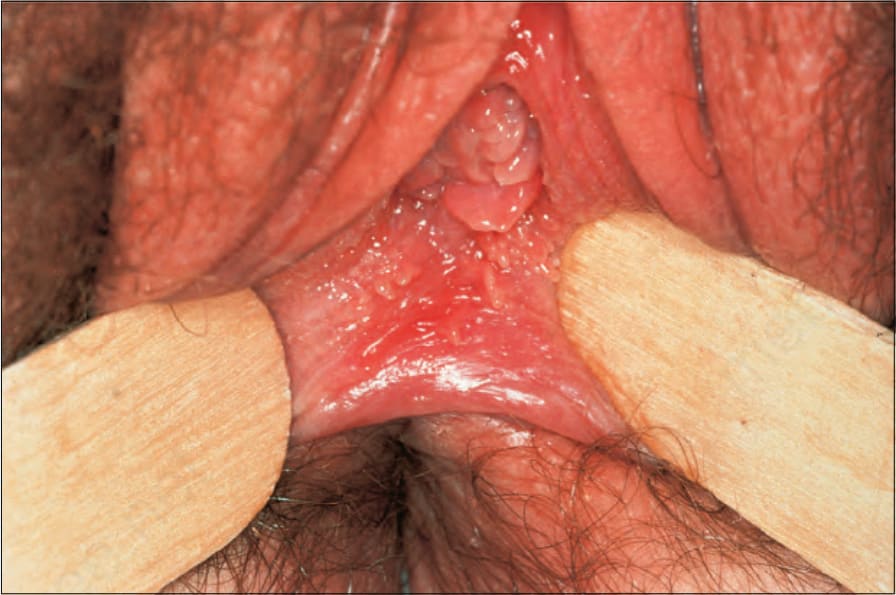
Fig. 12.14 Vestibular papillomatosis: numerous pale papillomata are present in the vestibule and on the labia minora. These are a normal finding and are particularly common in pregnancy. By courtesy of the Institute of Dermatology, London, UK.