Adult Blaschkitis
Adult Blaschkitis
Clinical features Adult Blaschkitis (acquired relapsing self-healing Blaschko dermatitis) is a rare, relapsing linear eruption with a mean age of onset of 40 years, predominantly affecting males.1–14 Lesions, which are pruritic papules and vesicles, affect multiple sites, particularly the trunk, following Blaschko lines and typically resolve in days or weeks.1 The condition, which may be unilateral or more commonly bilateral, recurs over the ensuing months or years.
257 Lichenoid dermatoses
Histologically, adult Blaschkitis is characterized by spongiotic changes often combined with focal interface inflammation; lichenoid features are rare, and deep involvement of adnexal structures is not often a feature.6,8
Differential diagnosis It resembles lichen striatus, and it has been suggested that there is no justification for separating the two entities.17 However, it differs clinically by the presence of vesicles, its truncal distribution, and relatively rapid resolution. Relapsing courses are typical. Pruritus is rare in lichen striatus. Lichen striatus predominantly affects young children although rare cases similar to adult Blaschkitis but affecting children have been described.
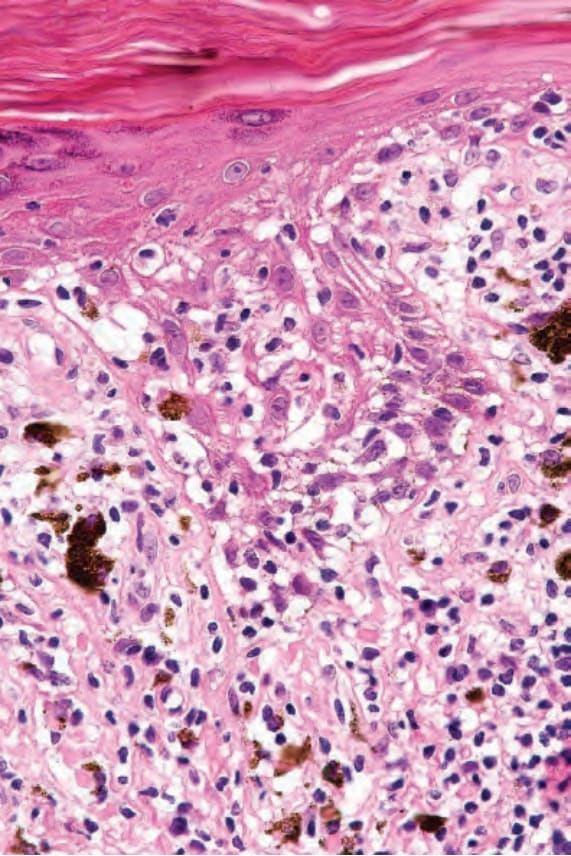
Fig. 7.55 Lichen striatus: there is spongiosis, marked lymphocytic exocytosis, basal cell liquefactive degeneration, and pigmentary incontinence. Case courtesy of S. Lyle, MD, Beth Israel Deaconess Medical Center, Boston, USA.
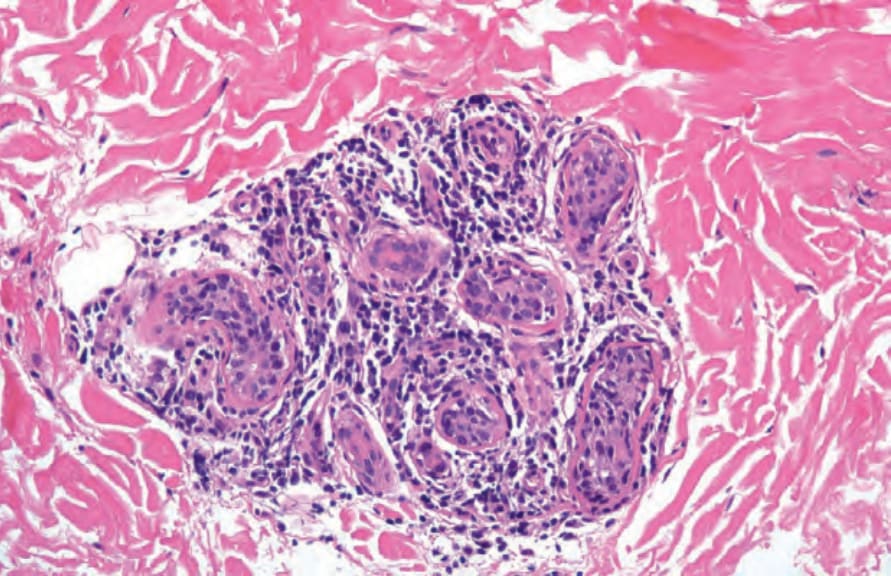
Fig. 7.57 Lichen striatus: note the perieccrine lymphocytic infiltrate.