Mucinous cyst
Mucinous cyst
Clinical features These are rare lesions in men that present as small flesh-colored, midline, translucent, mobile, papules (2 mm) to nodules (25 mm), usually easily
determined to be cystic on clinical grounds.1,2 They do not have a punctum. Either they are asymptomatic or they become infected or interfere with sex. They have usually been present from birth or childhood and are common near the glans penis or on the foreskin, but may occur anywhere from the urethral meatus to the anus and present at any age in life. The assessment of such cysts should involve the exclusion of secondary infection, for example, gonorrhea.
Vulval lesions are mainly seen in adult women and present as a solitary or, less often, multiple lesions in the vestibule.3,4 Rare cases are found in adolescents. This cyst arises as a result of obstruction of the duct of a minor vestibular gland. Simple excision is curative.
Pathogenesis and histologic features Lesions in women were thought to be derived from müllerian epithelium. It is more likely, however, that lesions in both men and women derive from ectopic urogenital sinus epithelium.2,4 The cyst is lined by a layer
523 Benign epithelial lesions
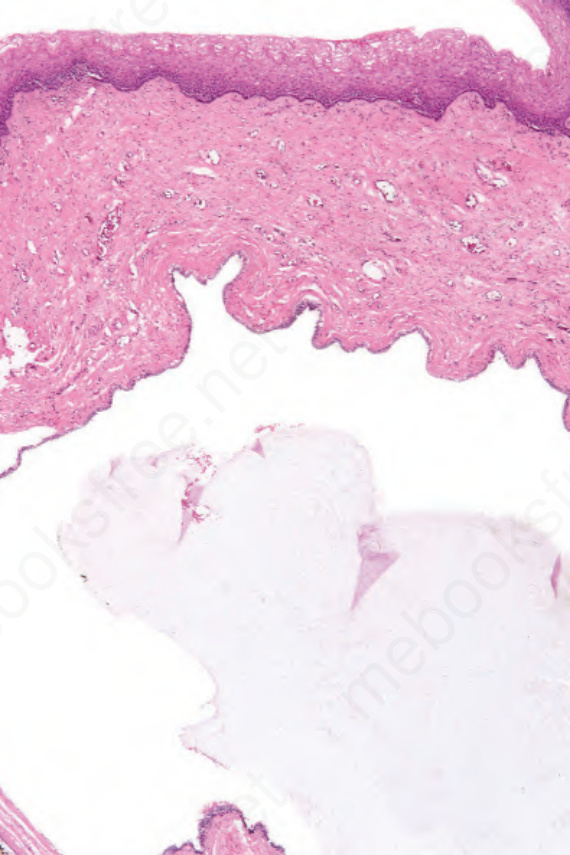
Fig. 12.174 Mucinous cyst: lowpower view of mucincontaining cyst. Note the nonkeratinizing surface epithelium. By courtesy of C. Crum, MD, Brigham and Women’s Hospital and Harvard Medical School, Boston, USA.
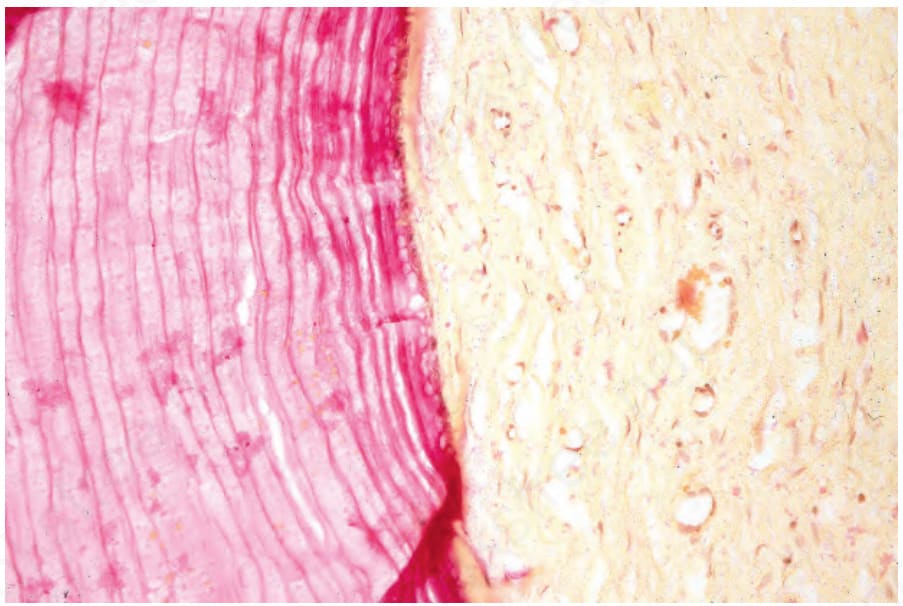
Fig. 12.176 Mucinous cyst: the mucin stains bright red with mucicarmine. By courtesy of C. Crum, MD, Brigham and Women’s Hospital and Harvard Medical School, Boston, USA.